 Vision & Prophecy
The Prophetic Psalms
Prophetic Psalms Introduction
The book of Psalms is an amazing book of the Bible in many ways. Beautiful, poetic writings throughout communicate many aspects of the life of a believer and the relationship with sin and God. The book has multiple authors with most of the chapters being written during the reign of King David. The Jewish tradition is that the book of Psalms is a book of poetry. However, there are many portions of the Psalms that are demonstrably prophetic in nature. In Acts 2:29-32 Peter tells us that David wasn't just a King, but also a prophet. My favorite example of a prophetic Psalm written by David is Psalm 22 which draws direct connection to the crucifixion of Jesus down to the details of mocking, gambling for His clothes, and pierced hands & feet — in an age where Crucifixion was not yet invented. And of course, Jesus's famous words on the cross are the first verse of this chapter showing that in that moment Jesus was pointing to this chapter and the fulfillment of it in the moment.
Further confirming the prophetic nature of the Psalms, we see in 1 Chronicles 25:1-2 that David set apart some men specifically for the ministry of prophesy — including Asaph (A Levite) who is the attributed author of 12 Psalms which are numbered 50 and 73-83. These chapters are a portion of the chapters I want to cover on this page. Skipping chapter 50 which is also prophetic, but is not consecutive and therefore irrelevant to this page, the chapters 73-83 appear to thematically correlate to recent and current events in Israel. Therefore, I believe that our current time is in the midst of prophecy and that these Psalms indicate we are about to enter the Tribulation Period. I believe this is actually confirmed by the chapter numbers themselves — more on that in the next section. Likewise, another set of Psalms written by David seem to correlate to the current timeframe in much the same way, chapter numbers and all. The combination of the two seems to thematically match to current events in the early chapters of the two selections and then progress into what appears to be themes that align with expected prophetic events in the Tribulation Period. These themes present themselves chapter by chapter in the order they should occur in the Tribulation Period culminating in Psalms 84-85 and 132-134 speaking of the Millennial Kingdom and Millennial Reign of Jesus that is found in Revelation 20:1-6.
Why Israel?
"Now learn the parable from the fig tree: as soon as its branch has become tender and sprouts its leaves, you know that summer is near; so you too, when you see all these things, recognize that He is near, right at the door. Truly I say to you, this generation will not pass away until all these things take place."
Matthew 24:32-34
You will find in studying the end times related prophecy of Daniel 9 that the timing of the Tribulation Period is directly related to the time decreed for the people of Israel. In the scripture from Matthew 24 presented above, Jesus speaks of looking to the fig tree for signs of the changing of the age. On the Fig Tree Identity page of this site I present evidence that the identity of the "fig tree" is Israel, and perhaps more specifically Jerusalem.
For the purposes of this page, in Matthew 24:32-34 Jesus states the generation that sees the sprouting of the fig tree would not pass away until the end times events he prophesied earlier in the same chapter had occurred. So, this scripture provides indication of the timing in which the end times events will occur. A quick word study of the word "generation" in the Bible will reveal that the Bible-defined duration of a generation is found in Psalm 90:10 as 70-80 years. As a confirmation of this, if you consider the history of Israel, you will find that there has never been a time that Israel has been a whole, established, independent nation for longer than 80 years — The Jerusalem Post actually highlighted this in an opinion piece in 2023. I go into a bit more depth on this subject in the next section. But, it seems we know the length of time Jesus may have been referring to, but when can we say that Israel has not just been planted, but "sprouted its leaves" and become a functional "plant"?
Why Start At Jerusalem As The Capital?
There's an argument to be made to count from the initial decree of Israel becoming a nation. However, I think we've passed the point in time where this pans out with the prophecy and foreshadows I highlight on this site. Instead, I believe the answer to why the establishment of Jerusalem as the capital is specifically the point of reference is found in 2 Samuel 2 & 5. In 2 Samuel 2:1-4 we find that David is made King over Judah. However, reading the next few chapters shows that the first thing that David was confronted with was competing with Saul's son Ish-bosheth and we see in 2 Samuel 2:11 that David's reign over only Judah lasted 7.5 years. This period ends in 2 Samuel 5 when David & his men conquer Jerusalem, establish it as the new capital of David's kingdom and David continues to reign overa ll of Israeh & Judah for 33 years.
The purpose in highlighting this is that the kingdom of Israel passes to Saul's son after 40 years of Sauls reign. Then his son is murdered and a few years later David conquers Israel. The "consecutive rule over all Israel clock" begins again at this conquest 7.5 years into David's reign (2 Samuel 2:11). He reigns over all Israel for 33 years, then Solomon reigns over all of Israel for 40 years (1 Kings 11:43) which makes 73 consecutive years of David's lineage reigning. Then in 1 Kings 12:16-19, when Solmon's son Rehoboam begins reigning, we find that Rehoboam loses control over every tribe except the tribe of Judah and thus the kingdom divides again before the 80th successive year of a complete Israel ruled by the line of David.
The purpose in highlighting this is that the kingdom of Israel passes to Saul's son after 40 years of Sauls reign. Then his son is murdered and a few years later David conquers Israel. The "consecutive rule over all Israel clock" begins again at this conquest 7.5 years into David's reign (2 Samuel 2:11). He reigns over all Israel for 33 years, then Solomon reigns over all of Israel for 40 years (1 Kings 11:43) which makes 73 consecutive years of David's lineage reigning. Then in 1 Kings 12:16-19, when Solmon's son Rehoboam begins reigning, we find that Rehoboam loses control over every tribe except the tribe of Judah and thus the kingdom divides again before the 80th successive year of a complete Israel ruled by the line of David.
There are two things to take away from the history lesson above: The indepentent & whole nation of Israel lasted less than 80 years for King David's lineage beginning at the conquest & establishment of Jerusalem by David 7.5 years into His reign. This confirms the 80 year generation and potentially casts foreshadowing on the fate of modern Israel, which strenghtens why we would look to count 80 years from the establishment of a whole, independent Israel.
Putting It All Together
If we take an extremely analytical approach to what Jesus communicated in Matthew 24:32-34, we can deduce that if the "sprouting sign" Jesus is speaking of is the establishment of Israel, and seemingly more specifically its "completion" with Jerusalem as its capital, then we should be able to count the years of a Biblical generation from the year these events occurred to recognize the season just as Jesus directed in Matthew 24.
Following WWII, in November of 1947, the UN General Assembly passed a resolution calling for the establishment of a Jewish state. Then on May 14, 1948 the British Mandate over a Palestinian state expired and the Jewish People's Council proclaimed from Tel Aviv the establishment of the State of Israel which was immedaitely recognized by the United States and the USSR and progressively recognized elsewhere. The Israeli government continued to develop and in January of 1950 they declared Jerusalem the capital of the State of Israel.
Now we have a start date, and a year count. So, we add the Biblically-supported generation duration of 80 years to the 1948 UN decree for Israel to become a Nation and the 1950 declaration of Jerusalem as the capital of Israel we get 2028-2030. I establish on the Seven Year Tribulation page of this site how to arrive at the conclusion that Israel will be under the authority of the beast of the sea from Revelation 13 for the second half of the Tribulation period. So, if this is to happen before the 80 year mark, it would happen no later than 2030. And, this also looks to potentially line-up with the correlation of the year ranges of the Prophetic Psalms chapter numbers summarized on this page — a certain number of years from the establishment of Israel (Years & Psalms 73-85) and also the Gregorian years that numerically align with the later chapter numbers (Psalms 124-134 = Years 2024-2034).
Now that we have an idea of how the Bible might be communicating the timing of the Tribulation Period, let's look at the text of each chapter with the expectation that we should see the events of the mid-point of the Tribulation Period (the conquest of Israel and the abomination of desolation set up) somewhere in the chapters correlating to 2028-2030 and therefore the beginning of the Tribulation period 3.5 years earlier (2024-2027), and the ending of the Tribulation period 3.5 years later (2031-2034). (Spoiler: they do).
Prophetic Psalms Overview
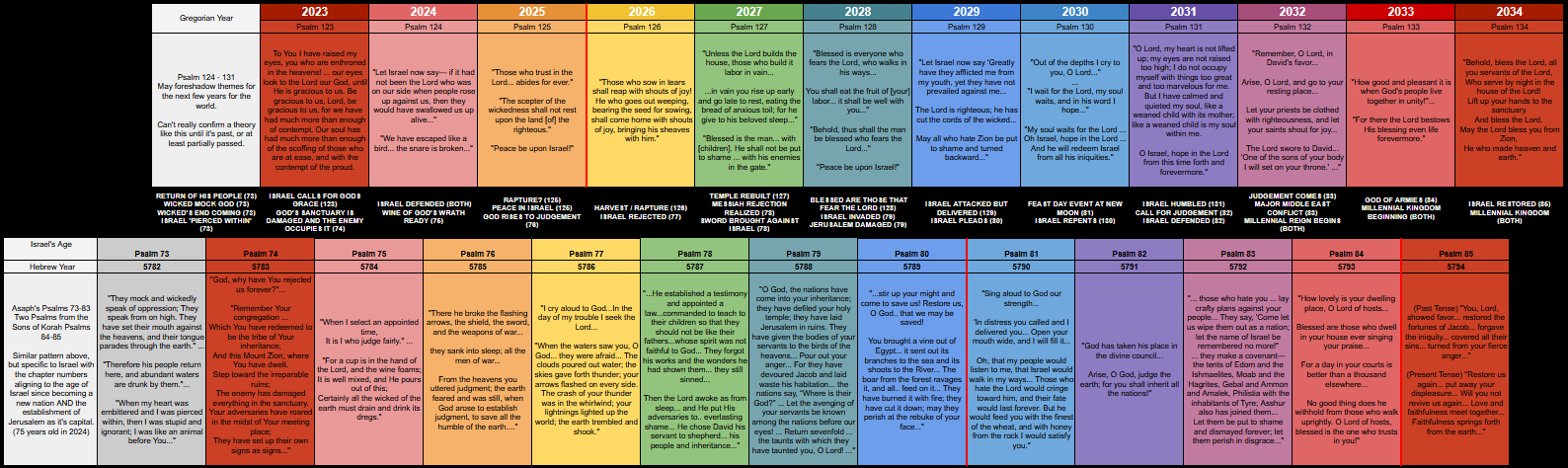
The End Times related prophetic Psalms communicate themes that when considered together in order seem to correlate to events of the Tribulation Period and the establishment of the Millennial Kingdom. The sets of chapters to consider are Psalms 124 - 134 (correlating to the gregorian year — I.E. 124 = 2024, 125 = 2025, etc.) and Psalms 75-85 (correlating to the age of a complete, independent Israel — I.E. Psalm 75 = 75 years old, Psalm 76 = 76 years old, etc). It's important to note at this point that the Hebrew year begins in the 7th month at Rosh Hashanah. So, the correlation of chapters & years are effectively offset around four months. I've presented the below summary list of the concept in this way. For example, I've listed Psalm 75 (Israel's 75th year) between Psalm 124 and 125 because it begins mid-way in 2024 (Psalm 124) and ends mid-way in 2025 (Psalm 125). I've also provided a graphical representation of this below. Consider how the highlights I summarize below align with the understanding I've provided of the Tribulation period events on the Seven Year Tribulation Page
- Psalm 124: Conflict & protection for Israel. This would also align with Daniel 12:1 at the beginning of the end.
- Psalm 75: Conflict & protection for Israel. Mention of judgement at an appointed time. Wine of God's wrath presented ready in His hand (ahead of Tribulation to begin)
- Psalm 125: Potential hint at the rapture by referencing believers dwelling with the Lord. Peace (treaty) for Israel mentioned at the end.
- Psalm 76: Conflict & protection for Israel (perhaps destruction following "saying peace & safety" in 1 Thes. 5:3). Judgement has been uttered and God has arisen to establish it.
- Psalm 126: Captive Israel, but hope promised. Harvest for one who sowed in weeping but gathering in joy might allude to rapture of believers by Jesus.
- Psalm 77: Israel rejected, remembering God's faithfulness in captivity & conflict in the past.
- Psalm 127: House built in vain (may be referring to the Third Temple)
- Psalm 78: Rejection of the Messiah realized — Israel established the Third Temple in yet another rejection of Jesus therefore the children are like the fathers.
- Psalm 128: Witness & ministry happening in Jerusalem by the temple. Promise of peace to come.
- Psalm 79: Invasion of Israel, Holy Temple defiled, witnesses killed & their bodies left to the birds (Rev 11, End of the first half of Tribulation).
- Psalm 129: Israel afflicted by a previous aggressor. The aggressor is then mowed down.
- Psalm 80: Israel calling for deliverance & restoration with acknowledgement of the Vine from Egypt (John 15:1), the Son of Man at the right hand of the Father.
- Psalm 130: Repentant Israel calling for forgiveness and help as they wait on the Lord.
- Psalm 81: A reference to a feast day at the new moon (Feast of Trumpets). Israel admonished for idolatry and God confirming He gave them over to it (Abomination of Desolation).
- Psalm 131: Israel waiting on the Lord
- Psalm 82: A call for God to administer justice and judge the Earth.
- Psalm 132: A mention to remember the promises made to David (establish David's lineage forever). Speaks of one sitting on the throne of David, and God's priests adorned in righteousness aligning with the initial establishment of the Millennial Kingdom and description of those who accompany Jesus in His second coming. This confirmed by the "horn of David spring forth there" referring to Jerusalem.
- Psalm 83: A call for God to deal with His enemies. This aligns with what Jesus will accomplish at His Second Coming.
- Psalm 133: Speaks of unity and life forever, which aligns perfectly for what the Millennial Kingdom would usher in.
- Psalm 84: Speaks of entering into the dwelling place of God, one sitting on the throne of David, and God's priests adorned in righteousness aligning with the initial establishment of the Millennial Kingdom and description of those who accompany Jesus in His second coming.
- Psalm 134: Speaks of the servants in the house of the Lord.
- Psalm 85: Speak of peace and blessing and restoration, which aligns perfectly for what the Millennial Kingdom would usher in.
After reading the list above and considering for yourself the text of each chapter, do you see how the themes of the chapters match the progression of the prophetic events of the Tribulation period?