 Vision & Prophecy
Millennial Days
God's Design for the Timeline of Mankind
The Biblical Pattern of Sevens
The Bible contains many patterns and symbols, with one of the most notable being the repeated use of sevens. A literal reading of select scriptures reveals a divine design in humanity's story, establishing a pattern that supports the suggestion of a 7,000-year timeline from creation to fulfillment — an idea matching the pattern of seven that is repeated throughout the Bible. I list some of what I think are the most consequential instances of this pattern below:
- In Genesis 1 & 2 give the account of the creation of the world with God completing all of creation in 6 days and establishing a seventh day of rest — we can be sure He is making a point because He is an omnipotent God without need for rest.
- In Exodus 20:8-11 God establishes the seven day week as one of His ten commandments as part of the covenant between Him and the Jewish people. In this portion of scripture, Moses stops relaying the commandments momentarily to highligh that this commandment is in alignment with the account of creation establishing the connection and pattern God is intending to communicate.
- We find the commandment recorded also in the Levitical law feasts in Leviticus 23:3, where God commands a seven-day week with the seventh day as a Sabbath rest.
- In Leviticus 25 introduces sabbatical years: every seventh year, the land rests, and every 50th year— the year after seven groups of seven— a jubilee marks both a celebration and the start of a new cycle. So now, the people are to record their weeks in sets of sevens and their years in sets of sevens.
- In Daniel 9, the prophet receives a vision of 70 "weeks" — seven prophetic year periods — representing prophetic periods for Israel, explored further in another study on this page.
- During Jesus's final week, He enters Jerusalem on the first day, is crucified midweek (exact day debated), and rises on the first day of the next week—again reflecting the seven-day pattern.
- Throughout the book of revelation the number seven is used in a variety of contexts each indicating completion of some kind.
- Click Here for more on the Bible's pattern of sevens.
A Day Is Like 1000 Years
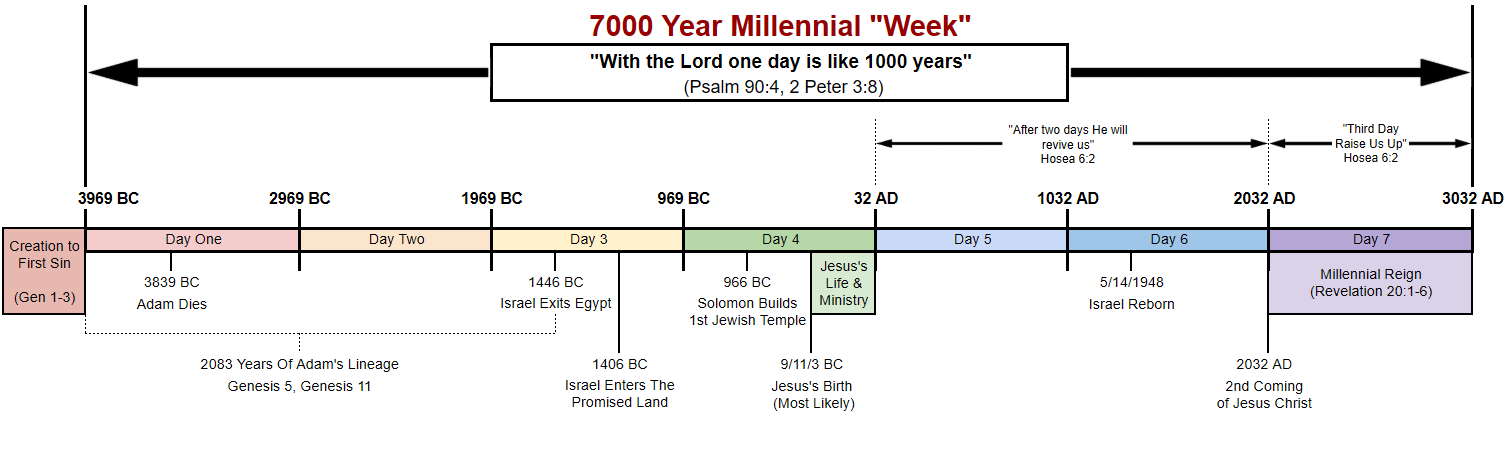
A few select verses suggest that in some cases, "day" in the Bible may represent 1,000 years from God's perspective.
- Psalm 90:4 contrasts God's eternal view with human life, saying a thousand years are like a day to Him.
- 2 Peter 3:8 echoes this, stating that with the Lord, a day is as a thousand years, and vice versa.
- In Genesis 2:17, God tells Adam he will die on the day he eats from the tree. A literal reading suggests immediate death, yet Genesis 5:3 says Adam lived 930 years. This implies "day" may mean more than 24 hours.
- Viewed through the lens of Psalm 90:4 and 2 Peter 3:8, Adam's death within a 1,000-year span supports the idea of a "Millennial Day"—he died on the same thousand-year "day" he sinned.
Verifying 4000 Years of
History Before The Crucifixion
- 445 BC - King Artaxerxes decrees the Jews may complete the rebuild of Jerusalem in his 20th year.
- 1010-970 BC - King David reigned
- 966 BC Solomon builds the temple in his 4th year as king
- 1446 BC - Israel Exits Egypt 480 years prior to Solomon's Temple
- 1876 BC - Israel (Jacob) entered Egypt from Canaan 430 years before the Exodus
- 1886 BC - Israel (Jacob) spent 10 years in Canaan before going to Egypt
- 3969 BC - Count the 2083 years of the lives of Adam's descendants to Abraham
- The above combined with the estimated 33 years of life of Jesus most likely born in 3 BC results in 4000 years exactly — An unlikely coincidence.
- (The count includes the year 3969, but no year zero)
- Therefore, as of the writing of this document we find ourselves 7 years shy of the 2000 year anniversary of the crucifixion and therefore approaching the beginning of the seventh millennial day from creation.
Further Corroborating Evidence
- The culmination of the above points indicates no more than 3 millennial days or 3000 years to follow the crucifixion of Jesus Christ to the final complete fulfillment of Biblical prophecy which is inclusive of the 1000 year reign of Jesus on Earth.
- Hosea 6:2 says, "After two days He will revive us; on the third day He will raise us up." Using the millennial day lens, we interpret that Israel is to be restored on the second of three millennial days, and then to be "raised up" on the third millennial day.
- Israel fell to Rome in 63 BC. Israel became a nation again in 1948 AD—2,011 years later—aligning with revival after two millennial "days" and fulfilling the "revival" in Hosea 6:2.
- Another witness to this same pattern is found in Exodus 19:10-11 where God tells Moses to consecrate the people for two days and have them ready for the third day in which the Lord will descend onto Mt. Sinai. Then we see in verses 16-17 Moses brings the people out to meet God — a foreshadow of the rapture.
- The "third day" also points to Israel's full restoration dwelling with God, during Christ's 1,000-year reign described in Revelation 20:4. This reign, following Jesus's return, aligns with the idea of Israel being "raised up" not only from the dead but elevated to the kingdom of heaven on earth.
- Jesus was crucified around 30–33 AD, placing our current modern day approximately two millennial days or 2000 years hence.
- The Millennial Reign on the seventh "millennial day," parallels the Sabbath — a day of rest—when Christ reigns as King.
- I do not mean to make the case that this verse EXCLUSIVELY speaks of Israel. The church is the "grafted branch" (Romans 11:17-24) and the "bride of Christ" (Ephesians 5:22-33) and therefore will have a prominent place in Jesus's Millennial Kingdom on the seventh millennial day prophescied in this verse.
- Altogether, this interpretation cohesively shows a 3,000-year timeline from the crucifixion to the fulfillment of these Biblical prophecies, including Jesus Christ's 1,000-year earthly reign.
The Seven Letters To The Seven Churches
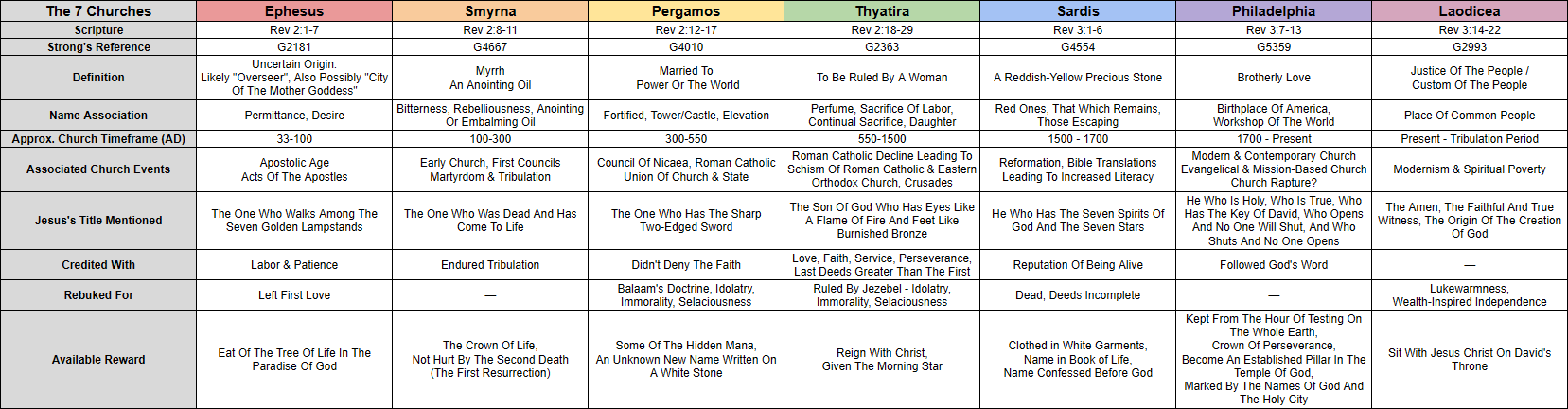
— In Revelation 1-3, we find a typological foreshadow of the progression of the church in the letters written by John to various churches that culminates in what I believe are foreshadows of the rapture and the end times.The purpose of presenting this here instead of one one of my other timing pages is to show that it's the current modern church associated with the church of Philadelphia that matches the timing pattern for the rapture. The thinking is that specifically for the letter to the church of Philadelphia the reward mentioned is to be removed from the hour of trial that is coming upon the whole world. This is a clear reference to the rapture prior to the Tribulation Period. As a result, while these letters are good for the self-examination and sactification of believers, the promise in the Philadelphia letter is not applicable to any believers who have come before us who were not in danger of living in the Tribulation Period in the first place. So, we find that the presence of this reward mentioned here is a hint that there's significance in these chapters not immediately obvious upon reading the first time through. If you brush up on church history and see the summary of the connections I've listed below, you'll find that the behaviors and characteristics of the highlighted churchs directly correlate to the development of the church from the crucifixion to modern day. As such, this is a microcosm of the church age and directly correlates to the 5th & 6th Millennial Days. Here are the verse selections, the translations of their names and the correlations:
- To Ephesus ("Overseer") - Revelation 2:1-7 - Correlating to the Apostolic Age
- To Smyrna ("Anointing Oil") - Revelation 2:8-11 - Correlating Period:
- To Pergamos ("Married To Power Or The World") - Revelation 2:12-17 - Correlating to The Council of Nicaea & The Union of Church & State Under The Roman Catholic Church
- To Thyatira ("Ruled By A Woman") - Revelation 2:18-29 - Correlating to the Roman Catholic Church and the subsequent Schism producing the Eastern Orthodox Church.
- To Sardis ("Precious Stone") - Revelation 3:1-6 - Correlating to the reformation which produced the protestant church and laid the ground work for the modern church era.
- To Philadelphia ("Brotherly Love") - Revelation 3:7-13 - Correlating to the modern church era of evangelicalism and mission-based church. The rewards associated with this era appear to mention the rapture.
- To Laodicea ("Justice of the People") - Revelation 3:14-22 - Appears to correlate to a current or future state of the church involving lukewarmness & diminished reliance on God due to reliance on wealth. I believe this is associated with the End Times period.
Other Supporting Verses For The Millennial Day Typology (Pattern)
— Job 5:19 says, "In six troubles He will save you; Even in seven, evil will not touch you." This looks to align with the notion of seven millennial days total with six "troubled" millennial days followed by a seventh day that is prophecied in Revelation to be the 1,000 year millennial reign of Jesus in which evil will have lost its power.
— The story of Jonah provides typology support for the death & resurrection of Jesus as well as the third day pattern. Jonah 1:17 states: "And the Lord designated a great fish to swallow Jonah, and Jonah was in the stomach of the fish for three days and three nights." This typology is even pointed out by Jesus in Matthew 12:40 where Jesus says, "for just as Jonah was in the stomach of the sea monster for three days and three nights, so will the Son of Man be in the heart of the earth for three days and three nights."
— Because the church is the body of Christ, Luke 24:46-47 provides typology support for two millennial days of suffering for the church and on the third day to be raised from the dead: "and He (Jesus) said to them, 'So it is written, that the Christ would suffer and rise from the dead on the third day, and that repentance for forgiveness of sins would be proclaimed in His name to all the nations, beginning from Jerusalem.' "
— In Genesis 5, we find a typological foreshadow of the millennial days through the names and details of the lives of the lineage from Adam. This illustrates a timeline overview of the account of the Bible and supports the notion of the Millennial Days and also the timing of the rapture and the Millennial Kingdom.
- Adam - "Man / Mankind / Earth / Red Dirt" - Signifies the origin of mankind.
- Seth/Sheth - "Appointed / Granted / Established" - Signifies an intentional start by God of Mankind in the 1st Age / 1st Millennial Day. We see in Genesis 4:26 that it's in the time of Seth that men began to call upon the name of the Lord which is that man began to worship. We also see this in the account of Seth's brothers Cain & Abel who sought to bring sacrifices to God.
- Enosh - "Weak / Mortal / Frail" - Signifies the state of man after the Fall which ultimately leads to the Flood in the 2nd Age / 2nd Millennial Day.
- Kenan/Cainan - "Possessor / Possession / Nest" - Signifies the land God gave to His people beginning with Abram in the 3rd Age / 3rd Millennial Day.
- Mahalalel - "Praise of God" - Signifies the continuation of Seth's lineage intentionally memorializing worship of the Lord. He correlates to the 4th Age / Millennial Day where the Messiah (the Only Begotten Son of God) makes His debut.
- Jared - "Descent" - Signifies the decline mankind takes from the first advent of the Messiah in the 5th Age / Millennial Day.
- Enoch / Chanak - "To Train / Dedicate / Inaugurate" - Signifies the progression (initiation, consecration, and preparation) of the church leading to the End Times in the 6th Age / Millennial Day. culminating in a rapture that illustrates there is hope for those in God's favor to be delivered from death. His age at his death also alludes to God's appointed timing - 365 years correlating to 365 days of our solar year.
- Methuselah - "Man of the Dart" - I must admit that I do not understand the significance in the name. But, Methuselah's significance in this foreshadow pattern is in the details of his life. He is the longest recorded human life at 969 years old. Which is nearly a full Millennial day. This signifies those living in the Millennial Kingdom with Jesus where the citizens of that kingdom will live long lives shown in Isaiah 65:20's "the youth will die at the age of a hundred."
- There's other significance to be found in the names of Genesis 5, but I will stop here as I've reached the end to my point regarding Enoch supporting the notion of the rapture in the 6th Millennial Day leading into the 7th Millennial Day.
Ecclesiastes 3 — Jewish & Christian Interpretations Intersect
In Ecclesiastes 3:1-8 we find Solomon lists that there is a season for everything under the heavens. He goes on to list 28 "times". If you divide the 7 millennial day 7000 years by 28 "times" you arrive at an average of 250 years for each "time". Each of the seven verses contains four separate times equating to representing 1000 years each. On it's own, this is really just a statement that both 7000 and 28 are divisible by 4. Until you understand that Jewish tradition is not 7000 years but rather 6000 years from creation to Messiah. When this same scripture is reviewed in that context, the 6000 years divided by 28 equals 214.2857142857143. If you then consider the current Jewish year is 5785 (with 5786 beginning in September of 2025) you should notice that 214 years from an expected 6000 year plan is 5786 (the next Jewish year) and the decimal remainder then tracks back 101 1/2 days (355 current hebrew year days x 0.2857142857143) into our current Hebrew year back from the Hebrew year transition on September 23. Counting 101.5 days from Rosh Hashanah on September 23 is June 14th which is the day the bombing of Iran by Israel began. From that day then some Jews believe the final "time for peace" in Ecclesiastes 3:8. This time for peace is associated with their expectation of the Messiah to come and usher in a time of peace. So, we find that this passage aligns with Jewish interpretation, tradition, and expectation of the Messiah as well as the Biblical 7000 year timeline. This also illustrates a means by which the Jewish people continue to expect what they did of the Messiah before Jesus was crucified and why they might be "set up" to accept a false messiah who comes at what appears to them and to us to be a prophetic time for different reasons. This false messiah acceptance is in alignment with the Millennial day theory explained above occuring within the seven years prior to the start of the 7000th year. I've embedded the video where I learned of this below: