 Vision & Prophecy
YHWH = "יהוה" = "I AM"
The ancient paleo-hebrew symbols reveal greater depth and interconnectivity of the Biblical text than is immediately apparent on the surface.
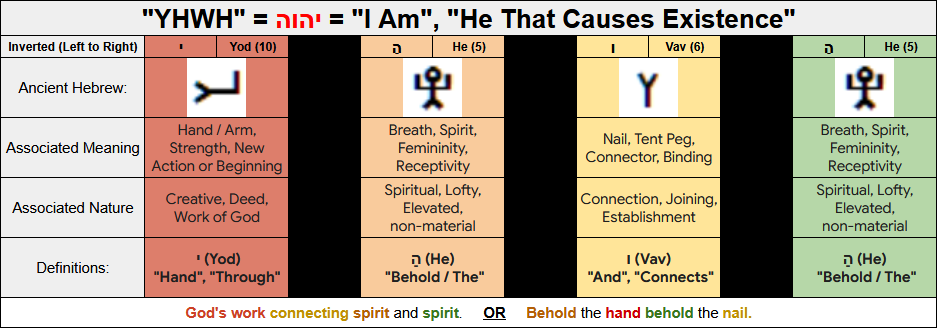
YHWH Overview
"I am the Lord (יְהוָ֖ה — Yahweh); that is my name!
Isaiah 42:8
In the Bible, there are different Hebrew words that are used to refer to God. Often, these words are translated "the LORD" or "The LORD God" despite them revealing different things about God. An example of this is the first mention of God in the Bible is found in Genesis 1:1 where the word "God" is a translation of the name "Elohim" (אֱלֹהִ֑ים) which translates to "Supreme God(s)". The first half of the word is "El" or "Eloah" which translates to "strong one"/"Almighty"/"object of fear or reverence"/"God of". This begins to describe the nature of God. Also notice that the name in this instance is in the Hebrew plural form indicated by the "him" on the end. But, the word is always used as grammatically singular. This indicates that God is singular, but also has a plurality that is true of Him. So, we find in the first verse of the Bible a hint at God's triune nature. I think I also see that this name could translate to "God of" (Eloah) "all" (him). This helps to illustrate that the different names used for God reveal different portions of His nature. But, this page is dedicated to another name of God we find in the next chapter of the Bible.
In the next chapter, found in Genesis 2:4, is the first mention of another name of God: Yahweh (יְהוָ֖ה). Found elsewhere throughout the text including the verse above, we find later in the Isaiah verse quoted above that this is the name that God gives for Himself to the prophet. While the exact pronunciation is unknown due to the lack of vowels, it is most widely believed that this name is "Yahweh". If so, it shares the Hebrew root word "hayah" — "the/to exist" which is another name used for God typically translated as "I AM". So, we find that God's name communicates that His essence is existence and as such it is a claim to the infinte, beginning-less and end-less nature of God. But, there's more meaning hidden in this special name of God when we look to break down the associated natures of the letters.
Hebrew Letter Meanings
Select a letter to explore its images and associated meanings. Read the word from right to left.
Yud


- Image Association:
- Hand, Arm
- Associated Nature:
- Hand, Work, Throw, Worship
This letter also has some association with an instance in time, particularly a beginning. As in God bringing something into existence with his hand.
Hey


- Image Association:
- Spirit, Man Raising Arms
- Associated Nature:
- Look, Behold, Breath, Sigh, Revelation
Vav


- Image Association:
- Nail, Tent Peg, Hook
- Associated Nature:
- And, Add, Connect, Join, Secure
Hey
- Image Association:
- Spirit, Man Raising Arms
- Associated Nature:
- Look, Behold, Breath, Sigh, Revelation
YHWH Associated Meanings - The Trinity in a Name
Using the associated meanings for each of the letters above, something amazing becomes apparent about this name of God. It describes multiple realities we see of God elsewhere in the text:
- He is Man's creator:
- "God causes the beginning (yud) of flesh (he) joined (vav) with spirit (he)."
- "God's hand gives (yud) breath (he) added to (vav) man (he)"
- By His design, He is intimately connected to His creation: "By God's hand (yud), His spirit (he) connects(vav) to our spirit(hey)."
- He is One with his Son: "Behold (he) the hand (yud), behold (he) the nail(vav)" — a direct reference to Jesus on the cross.
I can't help but also add that there's a few popular vidoes to be found on the internet connecting this name "YHWH" to the sound every person makes when they inhale (Yah) and exhale (Weh). In this way, the thing that sustains us as well as the first and last things that leave our mouths are a testament to the name of God.